

Max-funded IUL is an Indexed Universal Life (IUL) insurance policy strategically designed to maximize cash value accumulation alongside life insurance protection. Unlike traditional policies focused primarily on death benefits, a max-funded IUL approach emphasizes building substantial cash value by contributing the maximum allowable premiums. This permanent insurance vehicle combines a death benefit with a cash value component that earns interest tied to market index performance. The cash value component grows based on index returns while offering downside protection against market losses.
The max-funded IUL strategy involves contributing as much premium as legally permitted while ensuring the policy continues to pass Canada’s Exempt Test Policy (ETP) requirements under Regulation 306 of the Income Tax Act. Instead of paying only the minimum required premiums, policyholders intentionally maximize their contributions to accelerate cash value growth. Properly structuring a max-funded IUL requires expertise to optimize contributions while maintaining tax advantages under Canadian law. This is where IBC Financial’s specialists can help you navigate the complex CRA regulations and maximize your policy’s potential.
Key characteristics of max-funded IUL include:
People who pursue the max-funded IUL strategy typically seek both permanent life insurance protection and long-term, tax-advantaged wealth accumulation. With IBC Financial at your side, you have access to experienced Canadian advisors who specialize in designing max-funded IUL strategies tailored to your unique financial situation, helping you build wealth and secure your financial future.
Read ahead to discover everything about max-funded IUL strategies and determine if this approach aligns with your financial goals. We’ll explore the mechanics, benefits, potential drawbacks, and optimal applications of maximum-funded indexed universal life insurance in the Canadian context. When you’re ready to explore whether max-funded IUL is right for you, IBC Financial offers complimentary consultations to assess your needs and design a customized strategy.
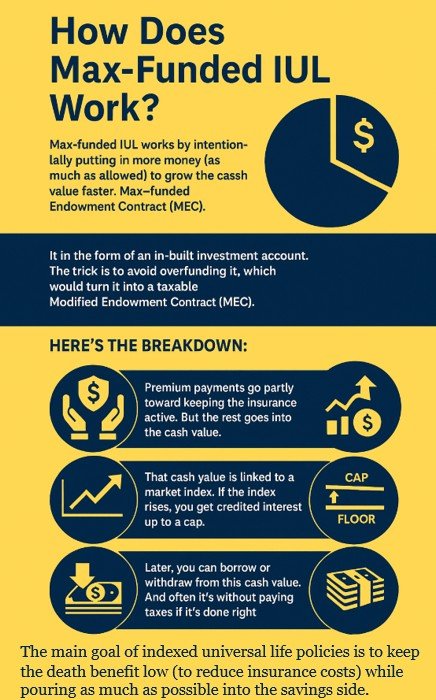
Max-funded IUL works by strategically contributing maximum allowable premiums to accelerate cash value growth within the policy’s indexed crediting structure. The max-funded IUL approach differs fundamentally from traditional life insurance, which focuses on minimum premium payments sufficient only to maintain death benefit coverage.
You can conceptualize max-funded IUL as life insurance with an integrated investment-style accumulation account. The key to successful max-funding in Canada is staying below the contribution limits defined by the Exempt Test Policy under Regulation 306 of the Income Tax Act to ensure your policy maintains its exempt status. If a policy fails the Exempt Test, cash value growth may become annually taxable — eliminating the key tax advantage that makes max-funded IUL attractive. IBC Financial’s advisors use proprietary calculators and industry expertise to determine your precise maximum funding level, ensuring you get optimal growth without crossing into non-exempt territory.
Here’s how the max-funded IUL mechanism operates:
The primary objective of max-funded indexed universal life policies is minimizing the death benefit (thereby reducing insurance costs) while maximizing contributions to the cash value component. This strategic approach transforms the IUL from simple death benefit coverage into a dual-purpose wealth accumulation and protection vehicle optimized for long-term financial planning. Getting the balance right requires careful policy design — IBC Financial works with top-rated Canadian insurance carriers to structure max-funded IUL policies that align with your wealth-building objectives while minimizing costs.
Max-funded IUL is a good idea if you need permanent life insurance protection combined with tax-advantaged wealth building potential. Whether a max-funded IUL strategy suits your situation depends on individual financial circumstances, goals, and risk tolerance.
The max-funded approach offers compelling benefits for income replacement, retirement income supplementation, and accelerated cash value accumulation. For some Canadians, max-funded IUL represents a powerful financial tool that complements registered accounts like RRSPs and TFSAs. For others, the complexity and cost structure may outweigh potential advantages.
Max-funded IUL makes sense if you:
However, max-funded IUL strategies involve notable drawbacks:
For individuals with long-term wealth-building objectives and appropriate budgets, max-funded IUL can provide powerful financial leverage. However, this strategy isn’t universally optimal for everyone. The decision requires careful analysis of your complete financial picture — schedule a consultation with IBC Financial’s experts to receive a personalized assessment of whether a max-funded IUL approach aligns with your family’s financial objectives and circumstances. Our team will compare max-funded IUL against other wealth-building strategies, including RRSPs, TFSAs, and corporate-owned life insurance, to determine the optimal solution for you.
The benefits of max-funded IUL include accelerated cash value growth, market downside protection, and tax-advantaged wealth accumulation. Max-funded IUL strategies also deliver flexibility in accessing accumulated funds and permanent death benefit protection. The floor protection feature shields your cash value from market dips and volatility.
The fundamental appeal of max-funded indexed universal life insurance lies in combining permanent insurance protection with a flexible, tax-advantaged wealth accumulation vehicle. The five primary benefits include:
This combination of market-linked growth potential with downside protection and tax benefits explains why higher-income Canadians and long-term planners frequently consider max-funded IUL strategies — particularly those who have maximized their registered plan contributions. IBC Financial specializes in maximizing these benefits through strategic policy design and ongoing management. Our clients receive comprehensive support including annual policy reviews, optimization recommendations, and access to premium carriers offering competitive caps and participation rates.
The downside of IUL includes lower guaranteed minimum interest rates compared to traditional participating whole life insurance. IUL policies also impose participation caps limiting your potential returns during strong market performance. Cash value growth directly correlates with market index performance, creating return variability from year to year.
Strong index performance can substantially increase IUL cash value. The S&P 500 index — comprising 500 companies representing approximately 80% of U.S. market capitalization — serves as the most popular benchmark for IUL crediting, though some Canadian carriers also offer crediting linked to the S&P/TSX Composite Index. When compared to guaranteed universal life insurance or participating whole life policies offered by Canadian insurers, the interest crediting rates for IUL involve more uncertainty. Additionally, participation caps on index gains affect both max-funded IUL and standard indexed universal life policies due to the insurance company’s hedging costs.
The complexity inherent in IUL products — with multiple variables affecting performance — makes these policies difficult for many consumers to fully understand. Multiple fee layers, including mortality charges, administrative costs, and premium expense charges, can substantially diminish net returns and policy performance. Without careful policy monitoring and adequate funding, an IUL policy may underperform expectations or even lapse. Canadian consumers should ensure they work with an advisor who holds appropriate provincial licensing and is experienced with exempt policy rules under the Income Tax Act.
Max-funded IUL is ideal for Canadians seeking permanent life insurance that emphasizes both cash accumulation and death benefit protection. The max-funded IUL approach particularly benefits those prioritizing tax-free death benefits combined with living benefits through cash value access.
Sophisticated investors seeking flexible policies with growth potential find max-funded IUL strategies particularly beneficial — especially Canadian business owners, incorporated professionals, and high-income earners who have exhausted their RRSP and TFSA room. For incorporated professionals such as physicians, dentists, lawyers, and engineers, a corporate-owned max-funded IUL can offer additional tax planning advantages by leveraging retained earnings within a corporation.
While max-funded IUL offers numerous advantages, it involves higher costs than term life insurance, making consultation with a qualified Canadian financial advisor crucial to determine alignment with your long-term strategy. This strategy works well as a component of comprehensive estate planning, business succession planning, and premium-financing arrangements for high-net-worth Canadians.
At IBC Financial, we provide comprehensive financial solutions enabling you to maximize wealth through strategic max-funded IUL implementation. Our advisors have helped hundreds of Canadian clients structure policies that deliver optimal results — we’ll analyze your income, tax situation, retirement goals, and estate planning needs to determine if max-funded IUL should be part of your strategy. We also help you compare this approach against alternatives like participating whole life insurance, RRSPs, TFSAs, and other wealth-building vehicles. Contact us today to receive your personalized max-funded IUL analysis.
Yes, max-funded IUL is generally safe due to floor protection that shields cash value from market downturns. Max-funded IUL policies provide minimum return guarantees (typically 0–1%), allowing policyholders to build supplemental retirement income with downside protection.
These insurance policies deliver not only death benefits but also valuable financial planning capabilities through maximum premium contribution options under Canada’s exempt policy framework. This structure allows individuals to accelerate cash value growth and access accumulated funds through withdrawals or policy loans. The safety of max-funded IUL depends on the policy’s specific design and the financial strength of the issuing insurance company. In Canada, life insurance companies are regulated federally by the Office of the Superintendent of Financial Institutions (OSFI) and policyholders benefit from coverage through Assuris — a not-for-profit organization that protects Canadian policyholders if a member life insurance company fails — providing an additional layer of security.
IBC Financial exclusively works with financially strong, highly rated Canadian insurance carriers. We also provide ongoing monitoring to alert you to any performance issues, giving you peace of mind that your wealth-building strategy remains secure.
If the market crashes, the max-funded IUL policy’s cash value growth will be negatively impacted or may credit zero interest for that period. During a market crash, a max-funded IUL’s death benefits and required premiums remain unaffected due to the policy structure. Only the cash value growth pauses during severe downturns, protected by the floor guarantee.
Max-funded IUL policies place cash value in accounts crediting returns based on stock market indexes such as the S&P 500 or S&P/TSX Composite. When markets grow, cash value increases proportionately, generating tax-deferred accumulation under Canada’s exempt policy rules. However, during market downturns, credited interest may fall to zero — though the floor prevents negative crediting. Periods of significant market volatility, such as those experienced in 2020 and again in 2025, illustrate how severe market events can affect cash value growth and, in some cases, require additional premium contributions to prevent policy lapse if cash value becomes insufficient to cover insurance costs. In such scenarios, participating whole life insurance from a Canadian mutual insurer may offer more stability. Max-funded IUL policyholders should monitor policy performance to ensure adequate funding levels.
IBC Financial provides proactive policy monitoring and market downturn strategies. During volatile periods, we’ll contact you with recommendations to ensure your policy remains properly funded. We also stress-test policies during the design phase to ensure they can withstand extended market downturns without lapsing.
Yes, you can withdraw money from your max-funded IUL policy through two primary methods. A max-funded IUL policy allows accessing accumulated cash through policy loans or direct cash value withdrawals.
You can access cash value through policy loans borrowed against the accumulated value or through partial withdrawals. Under Canadian tax law, policy loans from an exempt life insurance policy are generally not considered taxable income, creating a valuable tax-free income source in retirement. Accessing max-funded IUL cash value this way addresses financial needs without immediate tax consequences — a significant advantage of this strategy for Canadians seeking supplemental retirement income beyond their CPP, OAS, and registered plan withdrawals.
However, understanding withdrawal risks is critical. When you withdraw funds directly, it reduces your policy’s cash value and may trigger a policy gain that is taxable under the Income Tax Act to the extent withdrawals exceed your adjusted cost basis (ACB) in the policy. With diminished cash value, future interest crediting decreases proportionately. If cash value drops substantially, remaining funds may prove insufficient to cover policy fees and insurance costs, potentially causing the policy to lapse. Death benefits also decline proportionally as cash value is reduced.
The financial professionals at IBC Financial are prepared to help you optimize your max-funded IUL withdrawal strategy. We create customized income distribution plans that maximize tax-free access while preserving policy integrity and complying with CRA requirements. Our advisors will show you exactly how much you can safely access each year without jeopardizing your policy or triggering unexpected tax consequences.
Yes, you can use an IUL for infinite banking strategies in Canada. IUL is well-suited for the infinite banking concept due to its flexibility and potential for robust cash value growth within an exempt policy structure.
Implementing the infinite banking concept through a max-funded indexed universal life policy in Canada provides numerous advantages. It enables funding major purchases without traditional bank loans, reduces interest paid to financial institutions, and facilitates generational wealth building — all while keeping your capital working within an exempt, tax-advantaged policy. The infinite banking strategy leverages the cash value component of max-funded life insurance policies and is particularly effective for Canadian entrepreneurs, real estate investors, and long-term wealth builders looking to recapture interest they would otherwise pay to the major banks.
IBC Financial specializes in implementing infinite banking strategies using max-funded IUL for Canadian clients. Our advisors will design a policy optimized for infinite banking, teach you how to efficiently borrow against your cash value, and help you recapture interest you’d otherwise pay to Canadian banks and lenders. We’ve helped clients finance everything from real estate investments to business expansion to education costs using their max-funded IUL policies — all while building tax-free retirement income within a CRA-compliant structure.

Take the First Step to Financial Freedom!
We use cookies for analytics & functionality. Manage preferences.
Manage your cookie preferences below:
Essential cookies enable basic functions and are necessary for the proper function of the website.
Google reCAPTCHA helps protect websites from spam and abuse by verifying user interactions through challenges.
Statistics cookies collect information anonymously. This information helps us understand how visitors use our website.
Google Analytics is a powerful tool that tracks and analyzes website traffic for informed marketing decisions.
Service URL: policies.google.com (opens in a new window)
Marketing cookies are used to follow visitors to websites. The intention is to show ads that are relevant and engaging to the individual user.
Google Maps is a web mapping service providing satellite imagery, real-time navigation, and location-based information.
Service URL: policies.google.com (opens in a new window)
You can find more information in our Cookie Policy and Privacy Policy.